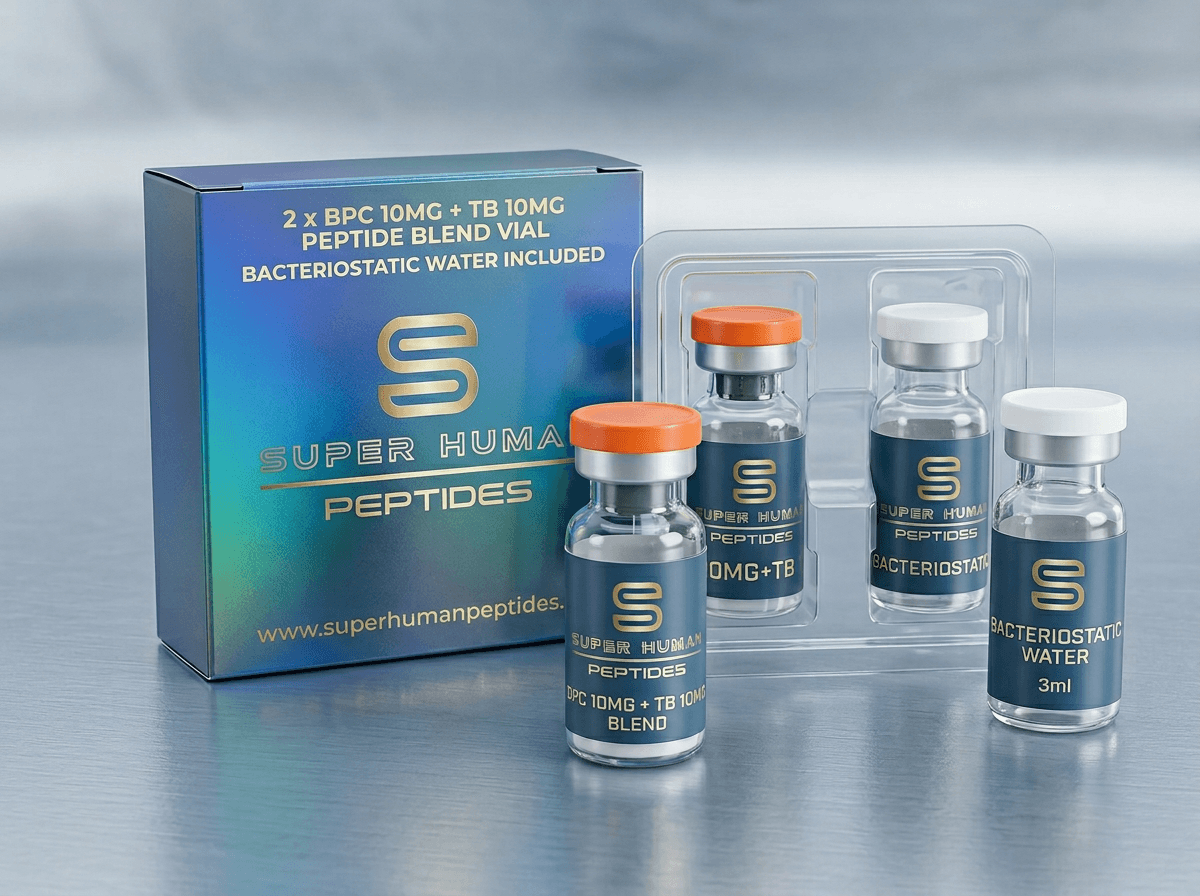
The GLOW Blend from Super Human Peptides UK is an exceptionally powerful, multi-pathway tissue regeneration matrix. It combines three of the most heavily researched repair peptides into a single, synergistic lyophilized compound: BPC-157 (10mg), GHK-Cu (50mg), and TB-500 (10mg). In laboratory research, this specific ratio is utilized to study complete, top-to-bottom cellular rejuvenation.
While BPC-157 and TB-500 work systemically to up-regulate angiogenesis (new blood vessel formation) and drive cellular migration to deep structural injuries (muscle, tendon, and gut), the massive 50mg inclusion of GHK-Cu focuses heavily on the extracellular matrix. GHK-Cu is an endogenous copper complex that signals the breakdown of damaged scar tissue and stimulates the massive production of new collagen and elastin. Produced under GMP-compliant conditions and verified for 99% purity or higher, the GLOW blend is the ultimate preclinical model for investigating profound dermatological repair, structural healing, and systemic anti-aging.
Note: Due to the high concentration of the copper-binding peptide (GHK-Cu), the lyophilized powder and reconstituted solution will possess a natural, distinct blue tint.
- —Tri-Peptide Synergy: Targets tissue repair from three distinct biological pathways simultaneously.
- —Deep Structural Repair: Utilizes BPC-157 and TB-500 for the rapid healing of muscle, tendon, and mucosal tissue.
- —Extracellular Matrix Remodeling: The high-dose GHK-Cu component actively breaks down damaged collagen and replaces it with healthy, elastic tissue.
- —Enhanced Angiogenesis: Creates massive networks of new blood vessels to deliver nutrients to regenerating cells.
- —High Purity: 99% purity or higher across all three peptide chains (verified by HPLC and MS analysis).
- —Quality Standard: GMP / ISO certified manufacturing.
- —Synergistic Angiogenesis: Studying the overlapping mechanisms of BPC-157 (VEGFR2 activation) and TB-500 to exponentially increase capillary growth.
- —Fibroblast Activation: Measuring the rapid influx of fibroblasts and the subsequent secretion of structural proteins (collagen and elastin) driven by GHK-Cu.
- —Scar Tissue Degradation: Investigating the unique ability of copper peptides to modulate metalloproteinases, breaking down tough, fibrotic scar tissue.
- —Tendon and Ligament Repair: Preclinical models exploring the accelerated healing of connective tissue via enhanced actin sequestration (TB-500) and tendon outgrowth (BPC-157).
- —Dermatological Remodeling: Evaluating the thickening of the epidermis, reduction of photodamage, and restoration of skin elasticity.
The GLOW blend represents the cutting edge of synergistic peptide research. Historically, these three peptides have been studied in isolation with profound results. Dr.
Loren Pickart discovered that GHK-Cu levels drop by over 60% as subjects age, leading directly to tissue breakdown and delayed healing. Restoring GHK-Cu in laboratory models proved to drastically up-regulate collagen production and skin repair. Simultaneously, researchers mapping BPC-157 and TB-500 demonstrated their ability to heal deep, severe systemic injuries.
When combined into a single matrix, laboratory models suggest a compounding effect. GHK-Cu signals the cleanup of damaged extracellular matrices; TB-500 physically alters the cellular cytoskeleton (via actin) to rush repair cells into the newly cleared area; and BPC-157 forms the vascular network necessary to keep those new cells alive. This tri-pathway approach makes it a premier focus for researching the reversal of severe biological decay and physical trauma.
- 1.Pickart, L. et al., "The human tripeptide GHK-Cu in prevention of oxidative stress and cognitive decline," Journal of Aging Research, 2012. (GHK-Cu).
- 2.Sikiric, P. et al., "Novel cytoprotective mediator, gastric juice peptide BPC 157," European Journal of Pharmacology, 1999. (BPC-157).
- 3.Philp, D. et al., "Thymosin beta4 and a synthetic peptide containing its actin-binding domain promote dermal wound repair," Wound Repair and Regeneration, 2003. (TB-500).
- 4.Pickart, L. et al., "GHK Peptide as a Natural Modulator of Multiple Cellular Pathways in Skin Regeneration," BioMed Research International, 2015.