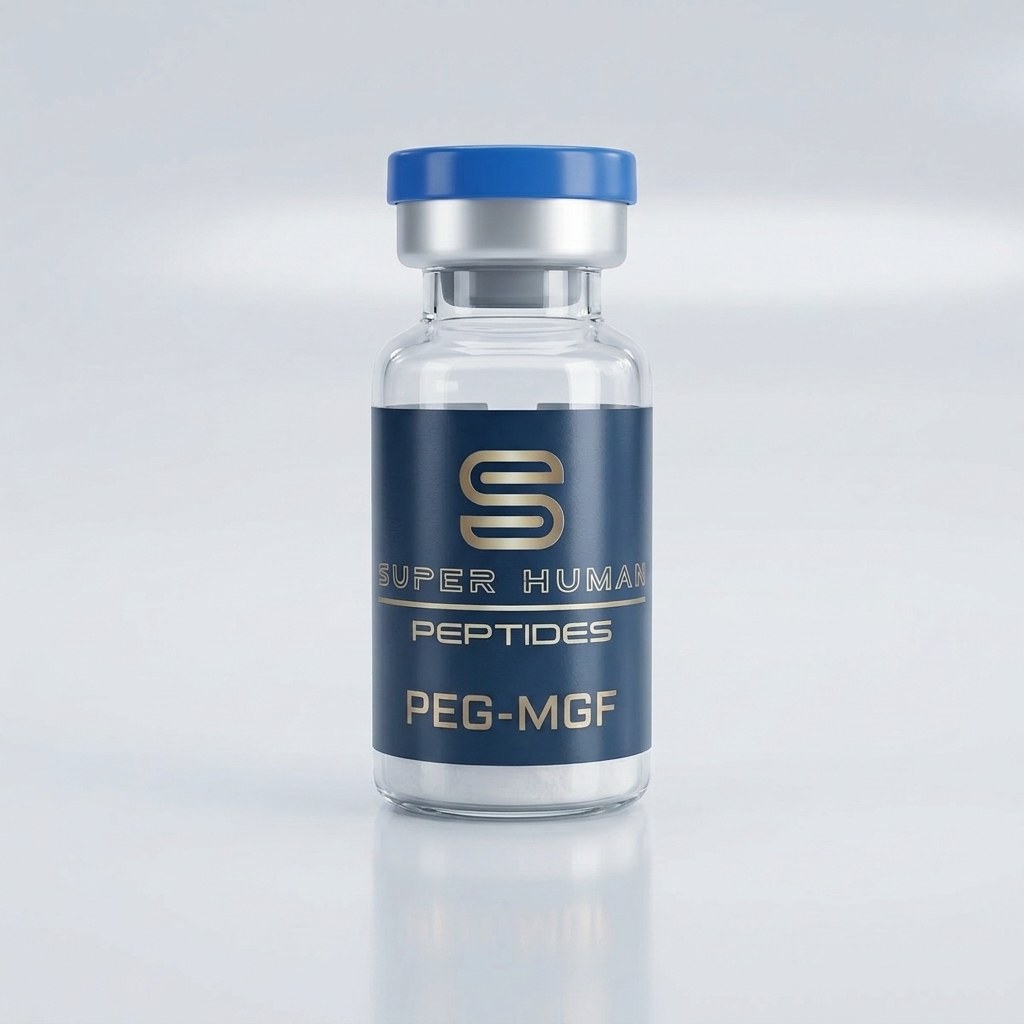
MGF (Mechano Growth Factor) from Super Human Peptides UK is an alternatively spliced variant of the Insulin-like Growth Factor-1 (IGF-1) gene, specifically known as the IGF-1Ec isoform in humans. In laboratory research, MGF is highly regarded for its unique role in tissue repair and muscle hypertrophy following mechanical stress or injury. Unlike systemic, liver-produced IGF-1, Mechano Growth Factor is expressed locally in muscle tissue.
Researchers utilize MGF to study the activation and proliferation of dormant satellite cells (muscle stem cells), allowing them to expand the stem cell pool before tissue differentiation occurs. Produced under GMP-compliant conditions and verified for 99% purity or higher, MGF is an essential model for studying mechanotransduction and localized cellular regeneration.
- —Localized IGF-1 Isoform: Specifically engineered to model the endogenous response to mechanical tissue damage.
- —Satellite Cell Activator: Triggers the proliferation of dormant muscle stem cells.
- —High Purity: 99% purity or higher (verified by HPLC and MS analysis).
- —Quality Standard: GMP / ISO certified manufacturing.
- —Documentation: Full Certificate of Analysis (COA) included with every batch.
- —Satellite Cell Proliferation: Studying the expansion of the stem cell pool following induced tissue trauma.
- —Mechanotransduction: Researching how physical force and mechanical stress are converted into chemical cellular responses.
- —Localized Repair Pathways: Comparing the acute autocrine/paracrine effects of MGF against the systemic, endocrine effects of standard IGF-1.
- —Muscle Wasting Models: Investigating potential interventions for sarcopenia, cachexia, and muscular dystrophies.
- —Neuroprotection: Emerging research into the peptide's ability to protect motor neurons from stress and ischemia in animal models.
Mechano Growth Factor was first identified and extensively characterized by Professor Geoffrey Goldspink and his team, who discovered that the IGF-1 gene is spliced differently in response to mechanical overload compared to normal endocrine secretion. Laboratory models demonstrate that after muscle damage, MGF is expressed rapidly to "kickstart" the healing process. Its primary observed function is to prevent premature differentiation—meaning it encourages stem cells to divide and multiply to create a large enough population to repair the damage, before a secondary shift toward mature muscle fibre creation occurs.
Because natural MGF has an exceptionally short half-life (acting only locally in minutes), it is utilized in highly targeted in-vitro and localized in-vivo studies.
- 1.Goldspink, G., "Mechanical signals, IGF-I gene splicing, and muscle adaptation," Physiology, 2005.
- 2.Yang, S. et al., "Cloning and characterization of an IGF-1 isoform expressed in skeletal muscle subjected to stretch," Journal of Muscle Research and Cell Motility, 1996.
- 3.Dluzniewska, J. et al., "A strong neuroprotective effect of the autonomous C-terminal peptide of IGF-1 Ec (MGF) in brain ischemia," The FASEB Journal, 2005.
- 4.Barton, E.R., "The expression of IGF-I isoforms in skeletal muscle," American Journal of Physiology-Cell Physiology, 2006.