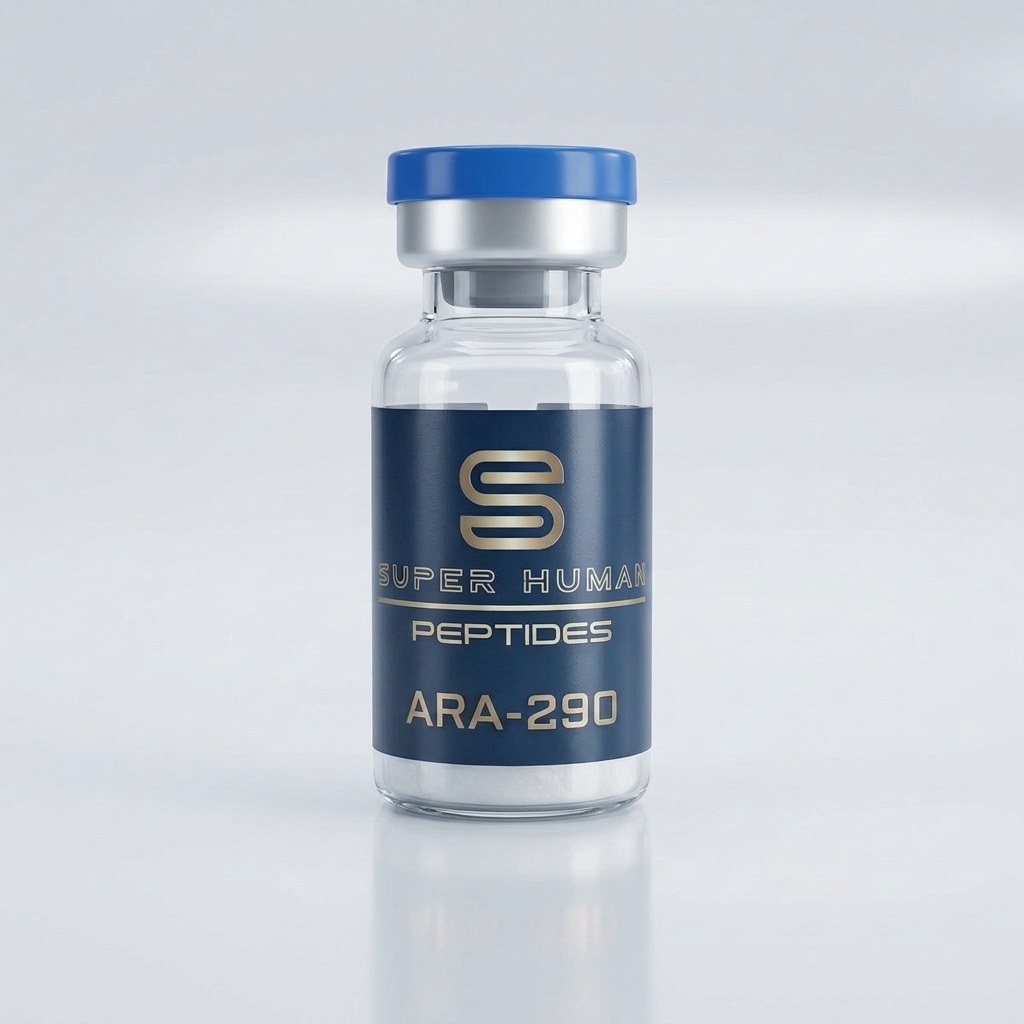
ARA-290 (Cibinetide)
ARA-290 (scientifically known as Cibinetide) from Super Human Peptides UK is a highly advanced, synthetic 11-amino-acid peptide. It is an engineered derivative of erythropoietin (EPO), the naturally occurring hormone famously known for stimulating red blood cell production. In laboratory research, ARA-290 represents a massive breakthrough in systemic defense and analgesia.
Native EPO possesses incredible tissue-protective properties, but its use in repair modeling is limited because it severely thickens the blood (erythropoiesis), leading to cardiovascular toxicity. ARA-290 solves this by acting as a non-erythropoietic analogue. It is structurally modified to completely bypass the classical EPO receptor, instead binding specifically to the Innate Repair Receptor (IRR).
By selectively activating the IRR, it halts systemic inflammation and repairs damaged nerve fibers without altering red blood cell counts. Produced under GMP-compliant conditions and verified for 99% purity or higher, ARA-290 is the premier preclinical model for investigating severe neuropathic pain, small fiber neuropathy, and autoimmune tissue salvage.
- —Innate Repair Receptor (IRR) Agonist: Specifically targets and activates the IRR to trigger profound anti-inflammatory and tissue-repair cascades.
- —Non-Erythropoietic: Uniquely engineered to deliver the tissue-protective benefits of EPO without stimulating red blood cell production or altering hematocrit levels.
- —Neuropathic Pain Analgesia: Heavily studied for its ability to drastically reduce severe, chronic nerve pain that is resistant to traditional opioid or NSAID models.
- —Small Fiber Neuropathy Repair: Demonstrated in clinical modeling to actually regrow damaged small nerve fibers (e.g., corneal nerve fibers).
- —High Purity: 99% purity or higher (verified by HPLC and MS analysis).
- —Quality Standard: GMP / ISO certified manufacturing.
- —Innate Repair Receptor Kinetics: Studying the highly specific binding affinity of the 11-amino-acid sequence to the heteromeric IRR complex during states of acute tissue trauma.
- —Small Fiber Neuropathy (SFN): Preclinical evaluation of the physical regeneration of microscopic nerve endings, particularly in models of sarcoidosis or diabetes-induced neuropathy.
- —Macrophage Polarization: Investigating the peptide's ability to shift the immune system's macrophages from a pro-inflammatory (M1) state to a tissue-repairing (M2) state.
- —Allodynia and Hyperalgesia: Measuring the dose-dependent reduction of severe pain responses in animal models subjected to chemical or mechanical nerve injury.
- —Ischemic Tissue Survival: Researching the prevention of cellular apoptosis in vital organs (heart, kidneys) following severe blood flow restriction and subsequent reperfusion.
ARA-290 was developed following the discovery of the Innate Repair Receptor by Dr. Anthony Cerami and his research team. They identified that the body produces the IRR specifically in response to severe injury or inflammation as a localized "distress signal" to initiate healing.
In landmark laboratory and advanced clinical modeling, ARA-290 has yielded spectacular results in treating conditions previously thought to be permanent. In rigorous studies targeting patients with sarcoidosis-associated small fiber neuropathy—a condition characterized by agonizing, untreatable nerve pain—ARA-290 not only significantly reduced pain scores but physically stimulated the regrowth of corneal nerve fibers. Furthermore, in animal models of myocardial infarction and acute radiation syndrome, it successfully prevented massive cellular death.
Because it selectively activates the body's ultimate survival and repair switch without cardiovascular risks, it is currently one of the most prioritized compounds in advanced pain management and immunology research.
- 1.Brines, M. et al., "ARA 290, a nonerythropoietic peptide engineered from erythropoietin, improves metabolic control and neuropathic symptoms in patients with type 2 diabetes," Molecular Medicine, 2014.
- 2.Dahan, A. et al., "Targeting the innate repair receptor to treat neuropathy," Pain, 2013.
- 3.Heij, L. et al., "Erythropoietin and ARA 290 in the treatment of neuropathic pain," Expert Opinion on Investigational Drugs, 2014.
- 4.Culver, D.A. et al., "Cibinetide Improves Corneal Nerve Fiber Abundance in Patients with Sarcoidosis-Associated Small Nerve Fiber Loss and Neuropathic Pain," Investigative Ophthalmology & Visual Science, 2017.